


BIWIN released the brand-new industrial-grade wide-temperature TGE408 eMMC, which is engineered with self-developed controller, built-in in-house firmware algorithms and domestic NAND Flash with full-process localization from IC design to tapeout and wafer manufacturing. In FBGA 153 Ball package, it follows eMMC 5.1 protocol, supports HS400 high-speed mode and operates under the temperature range from -40℃ to 85℃. Meanwhile, it’s equipped with exclusive Win-pSLC ultra-stable and endure architecture for balanced performance, reliability and durability, perfect for stability-critical areas such as power energy and industrial automation.
In-House Controller + Local NAND: Full-Stack Localization for Data Security
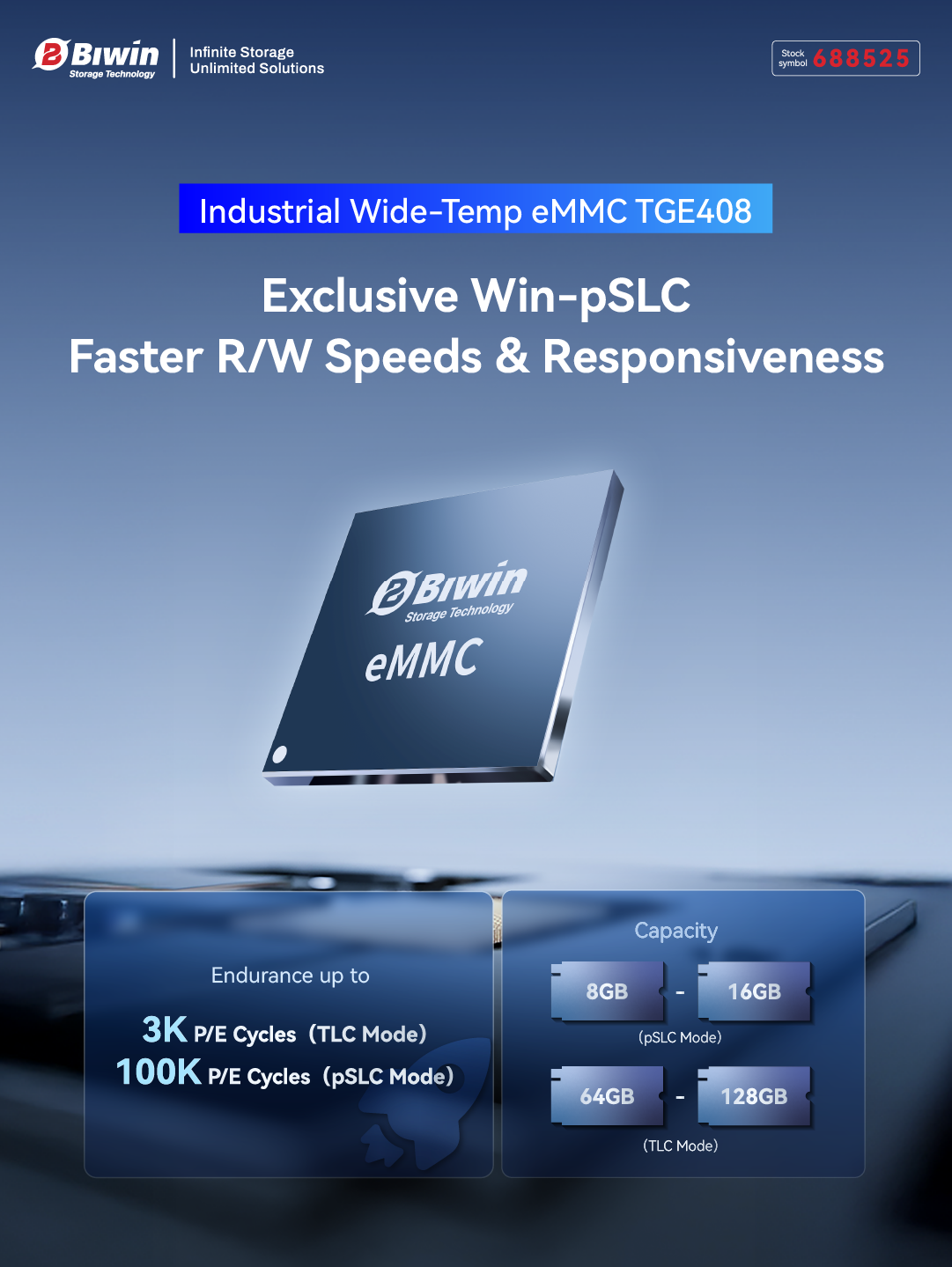
This new TGE408 eMMC features fully industrial-grade components and architecture design. Engineered with strictly-selected industrial NAND Flash, BIWIN in-house controller and packaging and manufacturing, TGE408 is able to ensure long-term supply stability and rapid customer response. It also offers capacities ranging from 8–16GB (pSLC mode) to 64–128GB (TLC mode), addressing diverse industrial storage requirements. Delivering sequential read/write speeds of up to 330MB/s and 220MB/s, this eMMC enables high-speed data transfer and real-time processing. It’s perfect for applications such as industrial automation, energy, robotics, smart security, rail transit, AIoT, and smart healthcare.

Wide Temperature Design (-40°C to 85°C): Reliable and Stable Under Extreme Conditions
Designed for reliable operation across -40°C to 85°C, the TGE408 eMMC maintains stable performance in extreme environments, including outdoor cold conditions, high-temperature industrial settings, and vibration-intensive scenarios such as rail transit and power inspection.
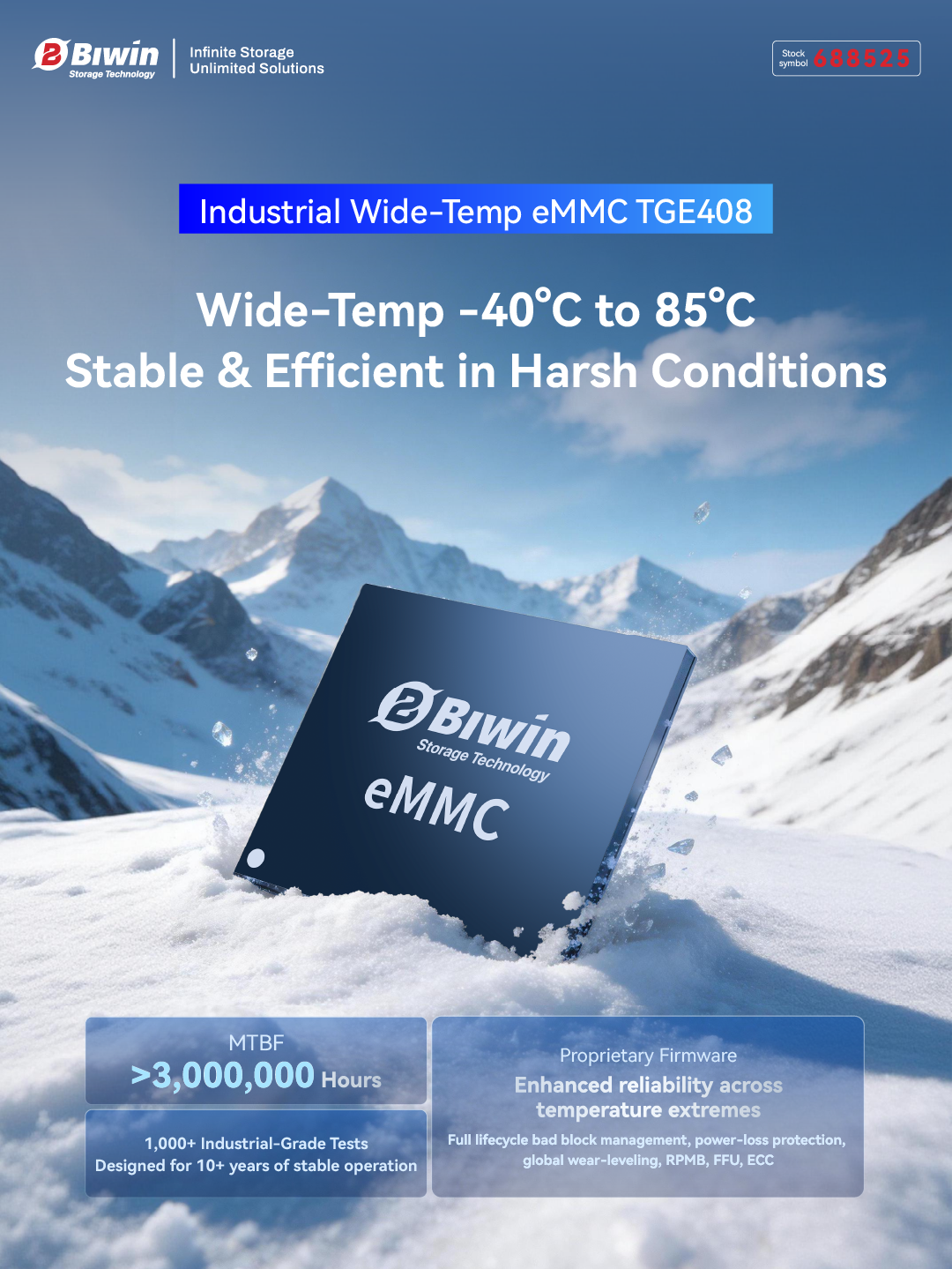
Enhanced with proprietary firmware strategies for high/low temperature optimization, it further improves performance stability in extreme environments and prevents data loss or system failure.
Win-pSLC Technology: Performance + Endurance Optimization
TGE408 eMMC, equipped with Win-pSLC firmware technology, significantly enhances read/write speeds and responding efficiency by simulating TLC mode as SLC mode. This helps maintain efficient data-processing capability even in high-load and intensive read/write scenarios.
In TLC mode, the device supports up to 3K P/E cycles, while in pSLC mode it reaches up to 100K P/E cycles. The product also delivers an MTBF of over 3 million hours, exceeding typical industrial-grade standards.
Built-in proprietary firmware algorithms support bad block management, wear leveling, and LDPC ECC, along with power-loss protection, ensuring data integrity and uninterrupted operation in the event of unexpected power failure.
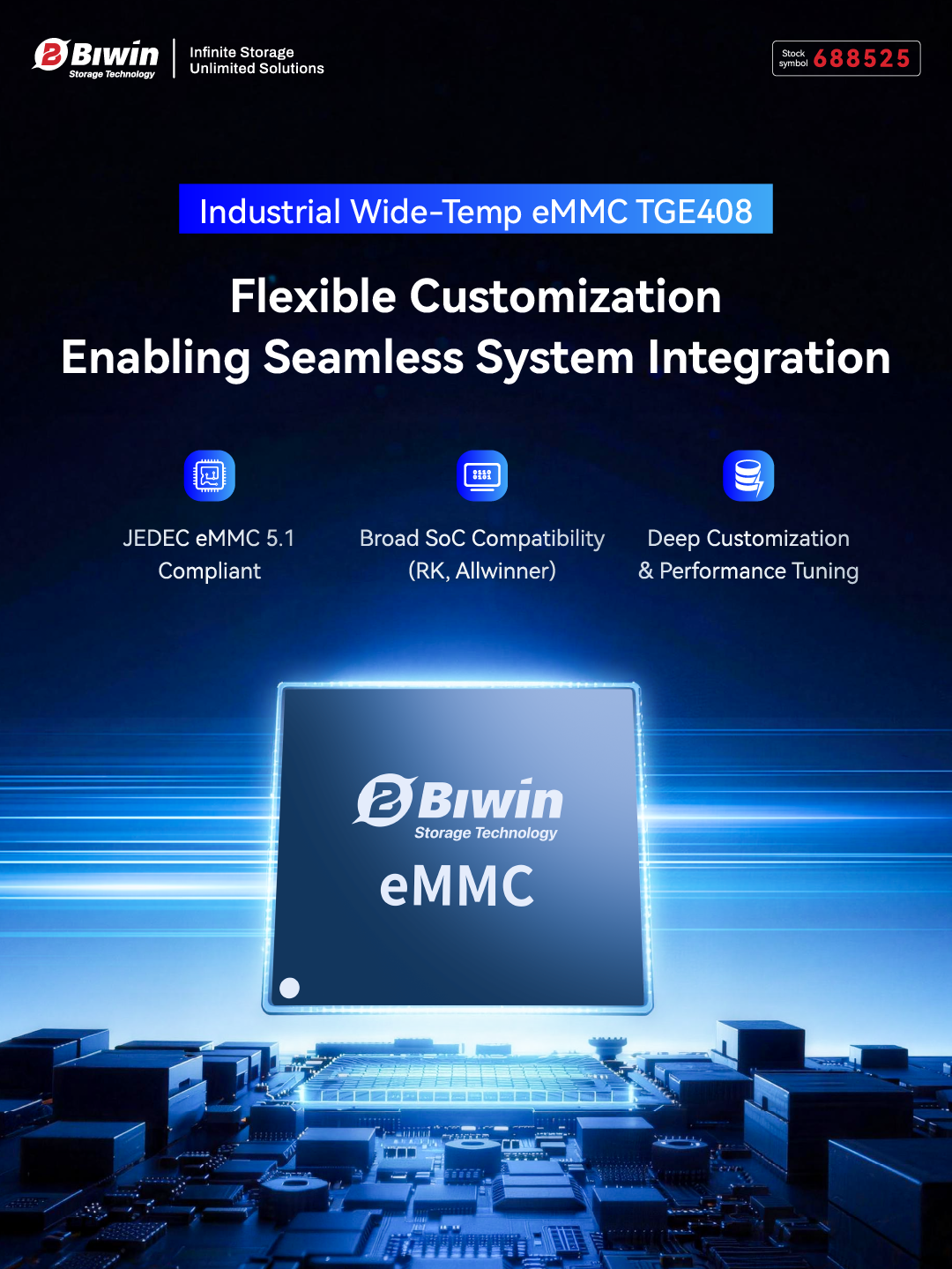
In addition, the in-house controller and proprietary firmware support multi-level customization, enabling performance and feature optimization based on specific application requirements. This allows deep synergy between the storage solution and the overall system, maximizing integration value and application-level adaptability.